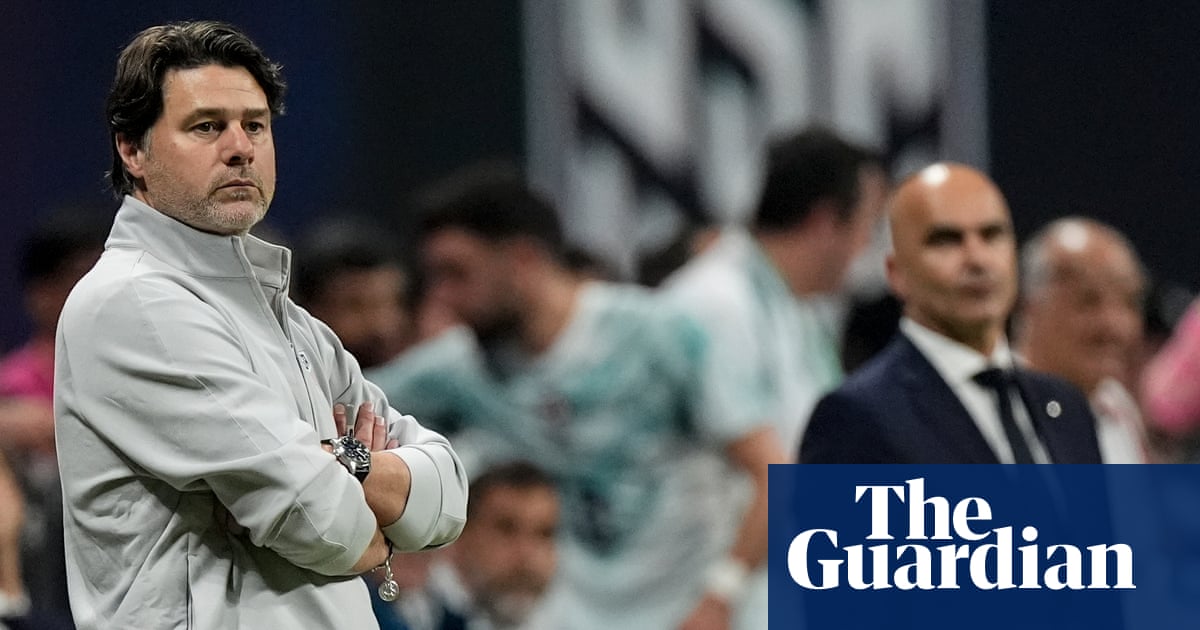
Roberto Martínez has long been easy with a smile. Those moments aren’t in short supply after wins like Tuesday’s, when Portugal comfortably dispatched the United States 2-0 in Atlanta.
That smile was on full display afterward, when he was asked for his thoughts on how the US look ahead of their home World Cup.
“I’ve got enough work with Portugal. I don’t think I can talk about the United States,” he said, before offering a reason for a beleaguered USMNT fanbase to keep faith. “As a team, the magic starts [when the US open the World Cup] on 11 June, and everything can be very different.”
The US will certainly hope Martínez, and his US counterpart, Mauricio Pochettino, are right. The US coach called Tuesday’s loss, as well as Saturday’s 5-2 drubbing against Belgium, defeats of “small details” where momentary mistakes were punished.
Pochettino’s closing remarks on the window balanced blame with bullishness. First, he said his team needed to play “more games” against opponents of this standard. Next, he implied both Portugal and Belgium were officiated more favorably because “some referees respect more big names.” Then, he reaffirmed his confidence in his team’s readiness for the summer: “I am more positive now than before, because seeing the team compete, we are not far away.” And then, a reality check: “Belgium and Portugal have, in the top 100 players, [a] few or some players in that top 100. I think we don’t have [any],” he said.
And, in closing: “we cannot be negative only because of the results. Of course, the results are negative.”
One can get whiplash as Pochettino alternates between sobering realism and fierce optimism with refrains like “why not us” and “we need to dream.” The wide array of responses suggests that he’s aware his team can’t go toe-to-toe with the World Cup favorites (or even its second-tier of hopefuls) on talent, and that they’ll need to be well-organized and locked in to make a deep run.
Pochettino also said he estimates somewhere between 35 and 40 players remain in contention for his 26-man squad. He and his staff will survey them closely in the coming weeks, as he intends to only bring his final squad for the final tune-up friendlies against Senegal and Germany. Yet in his final two games before that point, he completely changed his own framework – twice.
After the US thrived with a back-three system last autumn, Pochettino played Belgium using a back-four. The onslaught of pressure in the second half on Saturday was reminiscent of how the US were overrun in the Concacaf Nations League consolation match against Canada and the pre-Gold Cup friendlies against Turkey and Switzerland.
Pochettino reverted to a three center-back structure on Tuesday, and the mid-block did well to screen many of Portuguese star Vitinha’s attempts to break lines throughout the first half. There was, however, one confusing twist. Despite calling in three career center-forwards, who all arrived in fine goalscoring form with their clubs, he asked Christian Pulisic to lead the line for the first time in his 84 international appearances. Seemingly, the aim was to get his star winger back among the goals as his 2026 scoring drought enters a fourth month.
Pulisic’s movement in the role looked somewhat unnatural, but the US still generated multiple dangerous looks in the first-half. Pulisic and Malik Tillman did well to run behind Martínez’s high defensive line on to balls in open space. They’re the type of looks pacy forwards like Folarin Balogun and Patrick Agyemang are desperate for. Every bit a natural winger, Pulisic’s dribbling was just indirect enough – and his instinct to attack space or pass was just indecisive enough – for Tomás Araújo and Gonçalo Inácio to catch up. By the time Agyemang subbed on after half-time, Martínez had adjusted, slightly retreating his line of engagement and introducing Rúben Neves for midfield steel.
For Pochettino’s talk of “lessons” for his players, what did we learn from this window? There’s genuine potential with Weston McKennie and Malik Tillman operating alongside each other beneath the center-forward, offering for a variety of movement patterns and better progression in the half spaces. Chris Richards and Auston Trusty fared quite a bit better in Tuesday’s match than Tim Ream and Mark McKenzie did on Saturday, a fact which may help Trusty see more minutes in the tournament. The defense also looked more used to Matt Freese’s approach in goal than Matt Turner’s, cementing the NYC FC player atop the goalkeeping depth chart.
Yet somehow the questions have multiplied.
We don’t know how committed Pochettino is to retaining stability built upon three center-backs. We don’t know who combines for the most balanced midfield, or who he prefers to play in which role at the position. We don’t know his preferred formation, with four different looks having been utilized over the past three windows. We don’t know if this team are capable of protecting the edge of their box, as goals continue to leak in from long distance.
Most worryingly of all: it’s hard to argue that this window provided new evidence in favor of the US’s chances at a deep World Cup run. Even the moral victories from this window feel scarce and thin. Players needed cause for confidence. Outsiders needed signs that this team was rounding into something dependable at the 11th hour. The optics of Pochettino citing his opponents’ high standard look especially damning when rival Mexico, without many stars due to injury, were organized enough to earn draws against the same teams.
Martínez was right that hosts enjoy a unique boost when the World Cup’s spotlight find them. There’s just a lack of recent evidence to suggest the US are ready to contend in one of the tournament’s toughest groups, much less the business end. Turkey had claimed the final spot in the US’s group earlier on Tuesday. In all likelihood, the latecomers will (and should) feel capable of topping the group given the USMNT’s floundering form in March, as well as their comeback victory on American soil last summer. Australia and Paraguay are no pushovers, either.
World Cups have an outsized impact on the legacies of players and coaches, especially when the tournament comes to their back yard. If players are learning from Pochettino’s variable tests, they’ll now have to show it in biggest games imaginable.
That smile was on full display afterward, when he was asked for his thoughts on how the US look ahead of their home World Cup.
“I’ve got enough work with Portugal. I don’t think I can talk about the United States,” he said, before offering a reason for a beleaguered USMNT fanbase to keep faith. “As a team, the magic starts [when the US open the World Cup] on 11 June, and everything can be very different.”
The US will certainly hope Martínez, and his US counterpart, Mauricio Pochettino, are right. The US coach called Tuesday’s loss, as well as Saturday’s 5-2 drubbing against Belgium, defeats of “small details” where momentary mistakes were punished.
Pochettino’s closing remarks on the window balanced blame with bullishness. First, he said his team needed to play “more games” against opponents of this standard. Next, he implied both Portugal and Belgium were officiated more favorably because “some referees respect more big names.” Then, he reaffirmed his confidence in his team’s readiness for the summer: “I am more positive now than before, because seeing the team compete, we are not far away.” And then, a reality check: “Belgium and Portugal have, in the top 100 players, [a] few or some players in that top 100. I think we don’t have [any],” he said.
And, in closing: “we cannot be negative only because of the results. Of course, the results are negative.”
One can get whiplash as Pochettino alternates between sobering realism and fierce optimism with refrains like “why not us” and “we need to dream.” The wide array of responses suggests that he’s aware his team can’t go toe-to-toe with the World Cup favorites (or even its second-tier of hopefuls) on talent, and that they’ll need to be well-organized and locked in to make a deep run.
Pochettino also said he estimates somewhere between 35 and 40 players remain in contention for his 26-man squad. He and his staff will survey them closely in the coming weeks, as he intends to only bring his final squad for the final tune-up friendlies against Senegal and Germany. Yet in his final two games before that point, he completely changed his own framework – twice.
After the US thrived with a back-three system last autumn, Pochettino played Belgium using a back-four. The onslaught of pressure in the second half on Saturday was reminiscent of how the US were overrun in the Concacaf Nations League consolation match against Canada and the pre-Gold Cup friendlies against Turkey and Switzerland.
Pochettino reverted to a three center-back structure on Tuesday, and the mid-block did well to screen many of Portuguese star Vitinha’s attempts to break lines throughout the first half. There was, however, one confusing twist. Despite calling in three career center-forwards, who all arrived in fine goalscoring form with their clubs, he asked Christian Pulisic to lead the line for the first time in his 84 international appearances. Seemingly, the aim was to get his star winger back among the goals as his 2026 scoring drought enters a fourth month.
Pulisic’s movement in the role looked somewhat unnatural, but the US still generated multiple dangerous looks in the first-half. Pulisic and Malik Tillman did well to run behind Martínez’s high defensive line on to balls in open space. They’re the type of looks pacy forwards like Folarin Balogun and Patrick Agyemang are desperate for. Every bit a natural winger, Pulisic’s dribbling was just indirect enough – and his instinct to attack space or pass was just indecisive enough – for Tomás Araújo and Gonçalo Inácio to catch up. By the time Agyemang subbed on after half-time, Martínez had adjusted, slightly retreating his line of engagement and introducing Rúben Neves for midfield steel.
For Pochettino’s talk of “lessons” for his players, what did we learn from this window? There’s genuine potential with Weston McKennie and Malik Tillman operating alongside each other beneath the center-forward, offering for a variety of movement patterns and better progression in the half spaces. Chris Richards and Auston Trusty fared quite a bit better in Tuesday’s match than Tim Ream and Mark McKenzie did on Saturday, a fact which may help Trusty see more minutes in the tournament. The defense also looked more used to Matt Freese’s approach in goal than Matt Turner’s, cementing the NYC FC player atop the goalkeeping depth chart.
Yet somehow the questions have multiplied.
We don’t know how committed Pochettino is to retaining stability built upon three center-backs. We don’t know who combines for the most balanced midfield, or who he prefers to play in which role at the position. We don’t know his preferred formation, with four different looks having been utilized over the past three windows. We don’t know if this team are capable of protecting the edge of their box, as goals continue to leak in from long distance.
Most worryingly of all: it’s hard to argue that this window provided new evidence in favor of the US’s chances at a deep World Cup run. Even the moral victories from this window feel scarce and thin. Players needed cause for confidence. Outsiders needed signs that this team was rounding into something dependable at the 11th hour. The optics of Pochettino citing his opponents’ high standard look especially damning when rival Mexico, without many stars due to injury, were organized enough to earn draws against the same teams.
Martínez was right that hosts enjoy a unique boost when the World Cup’s spotlight find them. There’s just a lack of recent evidence to suggest the US are ready to contend in one of the tournament’s toughest groups, much less the business end. Turkey had claimed the final spot in the US’s group earlier on Tuesday. In all likelihood, the latecomers will (and should) feel capable of topping the group given the USMNT’s floundering form in March, as well as their comeback victory on American soil last summer. Australia and Paraguay are no pushovers, either.
World Cups have an outsized impact on the legacies of players and coaches, especially when the tournament comes to their back yard. If players are learning from Pochettino’s variable tests, they’ll now have to show it in biggest games imaginable.