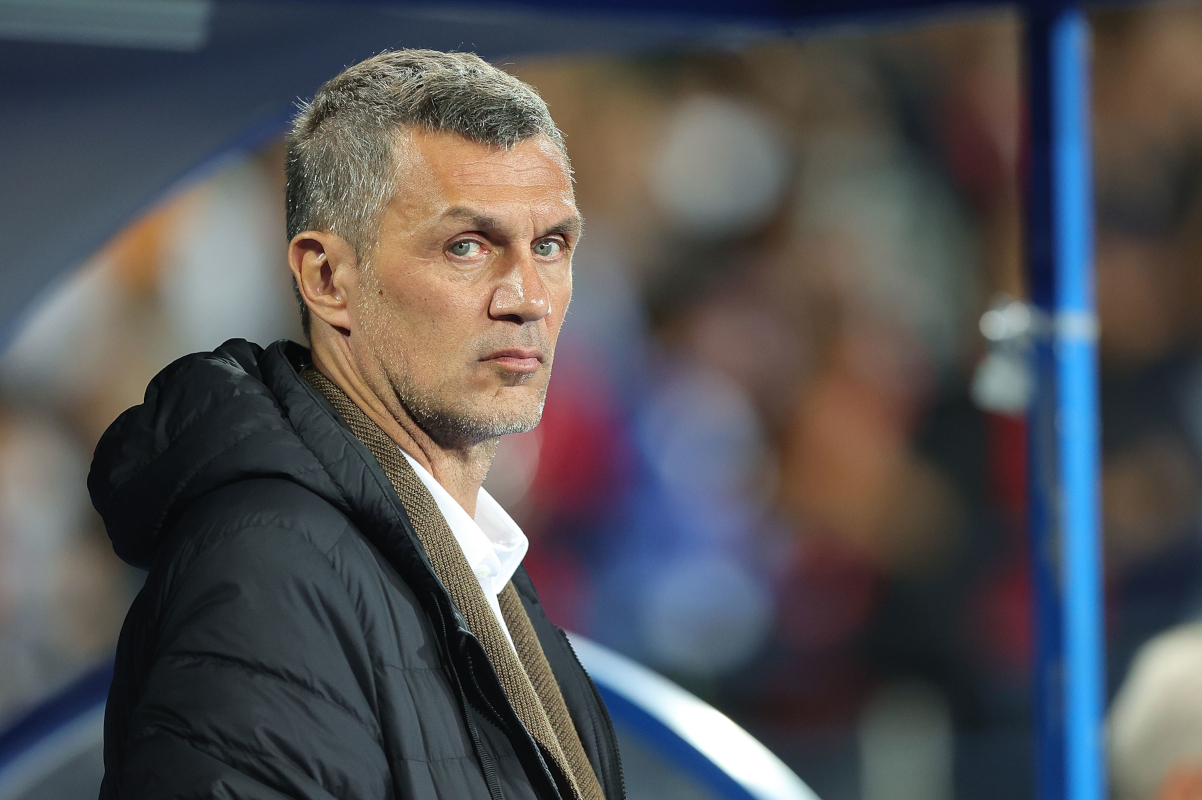
Paolo Maldini has spoken openly about his short-lived spell as the technical director of the FIGC, says that it is a ‘real shame’ how things panned out, has revealed what Pep Guardiola and Carlo Ancelotti told him, has spoken about his failed attempt to appoint Andrea Pirlo and has warned that the FIGC will not be getting it right if they focus all of their attention on the rebuilding of the Italy national team.
Maldini had been appointed as the technical director of the FIGC and was due to take over as President of Club Italia – the body that oversees football in every form and at every level and discipline in Italy – following the appointment of Giovanni Malago as FIGC President.
Maldini’s immediate priority was to identify a new head coach for the Italy national team. He had attempted to appoint Carlo Ancelotti and Pep Guardiola, but was met with rejections before attempting to hand the job to Andrea Pirlo, a move that was ultimately blocked.
The fact that Maldini felt he no longer had the authority that was promised to him at the time of his appointment led to his decision to resign from the role after just 17 days.
{rsn-smspc-splitter}
He has now spoken about his experiences in-depth in an exclusive interview with the Corriere della Sera.
Before getting into his experiences with the FIGC, Maldini paid tribute to his long-term friend and colleague Franco Baresi.
“Aside from the deep sadness, I watched the last 40 years of his life. I spent 25 with him. It wasn’t just a friendship. When you play alongside someone, you stay with them day and night, you have fun together, you win together, you bond indissolubly.
“Franco Baresi for me was an example of perfect leadership. He showed me how I wanted to be: Few words, plenty of actions.”
Maldini speaks about Malagò’s broken promise
Maldini was then asked about his own character after some critics labelled him a difficult individual to work with, despite his untouchable footballing CV.
“I don’t know, it’s the others who judge me and you can’t please everyone,” he replied. “I want to do things the right way and I want to say things clearly.
“People who have worked with me know me well, my teammates, my colleagues from my five years as a director at Milan. If a person who tried to assert their role and defined their duties is considered uncompromising, then I am uncompromising. If someone who takes responsibility, who tries to win but also accepts defeats is considered uncompromising, then I am uncompromising.”
Maldini went on to reveal all about his time as technical director of the FIGC, which, officially, only lasted for 17 days.
“Malagò called me at Easter saying that there was a possibility that he would become President of the FIGC: ‘You are the person I would like to have with me,’ he told me. I gave him my availability. In football, there are only two things for me: Milan and the national team.
“Then, I didn’t hear from him for a while. The day before the elections, Malagò called me back saying tomorrow there will be a vote, the chances are good, I’d like to have you on board. I told him: ‘let’s talk about it’.
“He asked me to become President of Club Italia. It wasn’t just a matter of relaunching the national team, we had to rebuild Italian football.”
Maldini was asked if he ‘needed’ Leonardo alongside him. The Brazilian had served as an advisor to Maldini during his brief spell back in the Italy set-up.
“I share friendship, values and principles with him. Leo has great organisational skills and understands me well. So we did it together. And we came up with a new role: The technical director. There had never previously been a technical director in the national team hierarchy, the coach would report directly to the President. But that wasn’t right.”
So, where did things start to go wrong then?
“The agreements were changed,” Maldini insisted. “The only thing to do was to resign, to give up on the four-year contract that was supposed to start on August 1.”
Maldini was then asked the question on many supporters’ lips: How did he accept the role without having an agreement with Malagò on the selection of a new head coach?
“Well, the first thing I asked was: ‘Who chooses the coach?’. Malagò replied: ‘The coach is up to you and I will endorse that’. That was the deal. Then certain events changed it.”
Maldini also faced criticism for claiming that it would take eight to 10 years to truly rebuild football in Italy and the men’s national team, which was widely considered too long a timeline.
“I told the Lega about our project, which focused on two different paths. The refounding of Italian football takes time. Training new players and bringing in a new mentality is a long journey. It required a new movement involving all parts of the FIGC: Serie A, Serie B, Serie C, the amateurs, the coaches’ association, the players’ and referees’ associations.
“Then there was the other path, which had to travel much faster because we will have to play against Belgium, Turkey and France in the Nations League in less than two months’ time. We had to prepare for tomorrow while also doing well today, and start winning again.”
Was Pirlo really the man that Italy needed? And if not him, then who else?
Maldini was then asked whether he truly thought Andrea Pirlo would be the man to get Italy off to a winning start in this new era.
He replied: “Our idea was linked to technique, to the attacking part of the game. We’d fallen behind on many things in Italy. We wanted to train youngsters on technique, one-on-ones, attacking mentality rather than just tactics. And we wanted a young coach who had a history in the national team. There were three names.”
So, who were those other names?
“Daniele De Rossi and Fabio Grosso,” Maldini revealed. “Three world champions. But, the President told us that according to the agreements that led to his election, with the support of all clubs apart from Lazio, we couldn’t touch any coaches from the Serie A teams.
“At the end of July, teams are already starting pre-season and it’s difficult to change paths. Malagò told us it couldn’t be done, so we went ahead with Pirlo.”
Maldini was asked if there were really no other options on the table.
He responded: “We made a call to the best Italian coach ever, to my friend Carlo Ancelotti. He replied saying that Brazil had reiterated their trust in hin, he wished us well and said good luck. A courteous phone call.”
Guardiola was already drafting formations for Italy
And what about Guardiola? Was he ever truly an option?
“He’s the coach who best embodies the technical and attacking part of the game. He had expressed the idea of wanting to coach a national team to a few friends of his. We went to visit him in Barcelona, we had lunch together, we talked for a whole day. He was very tempted. He came very close to accepting. He even started writing formations down on pieces of paper.”
Reports in Italy claimed that Guardiola wanted a salary of €20m per season to take over as head coach of the national team, which Maldini strongly denies: “Absolutely not. Money was never an issue. Pep told us clearly: Give me one euro less than what the previous coach took and I’m fine.”
So, why was Maldini unable to get Guardiola over the line, then?
“Because of exhaustion,” Maldini insists. “Guardiola is coming off the back of 10 gruelling years in the Premier League. He’s had back surgery, he wants to rest. But it was a very serious discussion, we studied the squads from the U17s upwards.
“So then we went with Andrea. Malagò knew everything, we’d informed him step-by-step.”
Why did Maldini resign after 17 days?
It was then put to Maldini that Pirlo is not a ‘winner’, certainly not to the same level as Guardiola or Ancelotti.
“That’s a personal consideration,” Maldini replied. “We wanted a young coach who would embrace the project and someone who had a career at a high level. Whenever I talk to Pirlo, I think he’s very well prepared. If accompanied by a technical director and an advisor, he would have been the ideal coach.”
The interviewer didn’t back down, hitting back and insisting that it isn’t a ‘personal consideration’ to say that Pirlo is not a winner given that he took a Juventus side that had won nine consecutive league titles and took them to a fourth-place finish.”
Maldini responded: “What CVs did the two previous World Cup winning coaches have? (Referring to Lionel Scaloni and Luis De La Fuente). If you think everything is linked to the coach that is on the bench, then you’re looking at things today, not for tomorrow. And we’re coming off the back of three missed qualifications.”
Maldini was then reminded that an 8-10 year period was too long a timeframe for most to stomach.
“That’s the only point where I was met with a bit of skepticism from the League. But that’s the time we estimated based on experience, not just of the big sides like England, France and Spain, but also of the other nations that rebuilt their footballing system like Switzerland. The rebuild needs everyone to be involved, and for everybody to communicate and help each other.”
Maldini was also asked about Pirlo’s ties to Russian betting sites and how that impacted his candidacy for the Italy national team job.
“I would say (it did have an effect). We didn’t know about it. Public opinion has done its job. But, there was nothing on a legal level that would have prevented Andrea from becoming the head coach of the national team.
“It was definitely exaggerated in a certain way. Pirlo was willing to end his relations with the Russian betting company. He’s a decent person, he didn’t deserve all this fuss. They brought out the code of ethics, a dignity decree. But, if there was a genuine desire to have him as head coach, there wouldn’t have been any legal obstacles.”
And what was Malagò’s role in denying Pirlo the opportunity to become the next head coach of Italy?
“He phoned me and Leonardo to say: ‘In my opinion, we can no longer go for Pirlo. From today, the coach is up to me. From today, the rules change, I decide on the coach and you endorse it’.
“But I had a job and responsibilities and I thought this was an unacceptable thing to say. We took 24 hours and then handed in our resignation, on a contract that hadn’t even started. I’m used to things being done in a different way. There was no longer the confidence that we needed to carry out an enormous job.”
What would Maldini’s Italy project have looked like?
So, where did Maldini want the project to start?
“It had already begun,” he replied. “We were at Coverciano, there are so many people who want to get things started but don’t know what to do. They’re waiting for indications, a goal. Meeting them gave us a lot of energy in a role that can be daunting.”
Maldini also denied that he had approached Thiago Motta about the job at one stage: “No, those were all the names.”
So, why did Maldini not want Roberto Mancini to be appointed?
“Imagine my not appreciating Roberto Mancini,” he chuckled. “But, we had different projects in mind. We wanted a new, younger coach. Mancini and Conte are two great coaches, and it’s not a question of ‘friendship’.
“It’s true, Pirlo is a friend of mine. I’m a friend of Ancelotti’s as well. I’m also friends with Mancini and Conte, albeit with different acquaintances. We’ve known each other for decades, we’ve played against each other, we played together in the national team.
“I reached the semi-finals of the 1988 Europs and the World Cup in Italy in 1990 alongside Mancini. With Conte, we reached the final of the 1994 World Cup and the 2000 Euros.
“But I didn’t choose people because they are my friends. I chose people who best fit the project at the time.”
And what would that project have looked like?
“A radical change,” Maldini insisted. “Completely different, more offensive methods, the training of new talents, support for the entire supply chain of the youth system. I would have become President of Club Italia, which is made up of 19 different teams: The youth sides, the women’s sides, futsal, beach soccer.”
Despite the fact that Mancini got the Italy job in the end, it had become clear that Antonio Conte would have been appointed had the Lega Serie A got its way.
“The Lega has acted properly, it also have me guarantees: If there was a need for help on an economic level, they would have been there. But they don’t know me that well. If I would have had to go in there and pick between two names that had already been proposed, one by Malagò and one by the League, what’s the point of calling me?
“I was told many times that they had their own favourite, that’s okay. But if you ask somebody to collaborate and you speak about a shared project, then you have to share it.”
Now, Claudio Ranieri will take on the role that had originally been handed to Maldini.
“His story speaks for itself,” Maldini said. “Having a figure like Ranieri is a bonus, exceptional even. I’m just saying that the work he has to do is enormous. I don’t know what’s been asked of him. I fear that a lot of importance will be given to the national team and less to the rebuilding of Italian football.”
And how does Maldini feel about it all today?
“I have a worry that I will carry inside. I took on a big, big commitment that had been a dream of mine, to do something for future generations and to bild a competitive Italy side. It was a great, but interrupted dream, also for the many people that had been willing to work with me.
“Do you know what Guardiola spoke to us at length about? Of the impact that Johann Cruijff had on Spanish football. For two years, everybody fought against him. But if Spain is able to create talents today, it is thanks to the groundwork that Cruijff laid.
“We don’t want to compare ourselves to him. But that was the way to go. Difficult, long-term, but it would have changed the identity of Italian football. It’s a shame, a real shame.”
Maldini had been appointed as the technical director of the FIGC and was due to take over as President of Club Italia – the body that oversees football in every form and at every level and discipline in Italy – following the appointment of Giovanni Malago as FIGC President.
Maldini’s immediate priority was to identify a new head coach for the Italy national team. He had attempted to appoint Carlo Ancelotti and Pep Guardiola, but was met with rejections before attempting to hand the job to Andrea Pirlo, a move that was ultimately blocked.
The fact that Maldini felt he no longer had the authority that was promised to him at the time of his appointment led to his decision to resign from the role after just 17 days.
{rsn-smspc-splitter}
He has now spoken about his experiences in-depth in an exclusive interview with the Corriere della Sera.
Before getting into his experiences with the FIGC, Maldini paid tribute to his long-term friend and colleague Franco Baresi.
“Aside from the deep sadness, I watched the last 40 years of his life. I spent 25 with him. It wasn’t just a friendship. When you play alongside someone, you stay with them day and night, you have fun together, you win together, you bond indissolubly.
“Franco Baresi for me was an example of perfect leadership. He showed me how I wanted to be: Few words, plenty of actions.”
Maldini speaks about Malagò’s broken promise
Maldini was then asked about his own character after some critics labelled him a difficult individual to work with, despite his untouchable footballing CV.
“I don’t know, it’s the others who judge me and you can’t please everyone,” he replied. “I want to do things the right way and I want to say things clearly.
“People who have worked with me know me well, my teammates, my colleagues from my five years as a director at Milan. If a person who tried to assert their role and defined their duties is considered uncompromising, then I am uncompromising. If someone who takes responsibility, who tries to win but also accepts defeats is considered uncompromising, then I am uncompromising.”
Maldini went on to reveal all about his time as technical director of the FIGC, which, officially, only lasted for 17 days.
“Malagò called me at Easter saying that there was a possibility that he would become President of the FIGC: ‘You are the person I would like to have with me,’ he told me. I gave him my availability. In football, there are only two things for me: Milan and the national team.
“Then, I didn’t hear from him for a while. The day before the elections, Malagò called me back saying tomorrow there will be a vote, the chances are good, I’d like to have you on board. I told him: ‘let’s talk about it’.
“He asked me to become President of Club Italia. It wasn’t just a matter of relaunching the national team, we had to rebuild Italian football.”
Maldini was asked if he ‘needed’ Leonardo alongside him. The Brazilian had served as an advisor to Maldini during his brief spell back in the Italy set-up.
“I share friendship, values and principles with him. Leo has great organisational skills and understands me well. So we did it together. And we came up with a new role: The technical director. There had never previously been a technical director in the national team hierarchy, the coach would report directly to the President. But that wasn’t right.”
So, where did things start to go wrong then?
“The agreements were changed,” Maldini insisted. “The only thing to do was to resign, to give up on the four-year contract that was supposed to start on August 1.”
Maldini was then asked the question on many supporters’ lips: How did he accept the role without having an agreement with Malagò on the selection of a new head coach?
“Well, the first thing I asked was: ‘Who chooses the coach?’. Malagò replied: ‘The coach is up to you and I will endorse that’. That was the deal. Then certain events changed it.”
Maldini also faced criticism for claiming that it would take eight to 10 years to truly rebuild football in Italy and the men’s national team, which was widely considered too long a timeline.
“I told the Lega about our project, which focused on two different paths. The refounding of Italian football takes time. Training new players and bringing in a new mentality is a long journey. It required a new movement involving all parts of the FIGC: Serie A, Serie B, Serie C, the amateurs, the coaches’ association, the players’ and referees’ associations.
“Then there was the other path, which had to travel much faster because we will have to play against Belgium, Turkey and France in the Nations League in less than two months’ time. We had to prepare for tomorrow while also doing well today, and start winning again.”
Was Pirlo really the man that Italy needed? And if not him, then who else?
Maldini was then asked whether he truly thought Andrea Pirlo would be the man to get Italy off to a winning start in this new era.
He replied: “Our idea was linked to technique, to the attacking part of the game. We’d fallen behind on many things in Italy. We wanted to train youngsters on technique, one-on-ones, attacking mentality rather than just tactics. And we wanted a young coach who had a history in the national team. There were three names.”
So, who were those other names?
“Daniele De Rossi and Fabio Grosso,” Maldini revealed. “Three world champions. But, the President told us that according to the agreements that led to his election, with the support of all clubs apart from Lazio, we couldn’t touch any coaches from the Serie A teams.
“At the end of July, teams are already starting pre-season and it’s difficult to change paths. Malagò told us it couldn’t be done, so we went ahead with Pirlo.”
Maldini was asked if there were really no other options on the table.
He responded: “We made a call to the best Italian coach ever, to my friend Carlo Ancelotti. He replied saying that Brazil had reiterated their trust in hin, he wished us well and said good luck. A courteous phone call.”
Guardiola was already drafting formations for Italy
And what about Guardiola? Was he ever truly an option?
“He’s the coach who best embodies the technical and attacking part of the game. He had expressed the idea of wanting to coach a national team to a few friends of his. We went to visit him in Barcelona, we had lunch together, we talked for a whole day. He was very tempted. He came very close to accepting. He even started writing formations down on pieces of paper.”
Reports in Italy claimed that Guardiola wanted a salary of €20m per season to take over as head coach of the national team, which Maldini strongly denies: “Absolutely not. Money was never an issue. Pep told us clearly: Give me one euro less than what the previous coach took and I’m fine.”
So, why was Maldini unable to get Guardiola over the line, then?
“Because of exhaustion,” Maldini insists. “Guardiola is coming off the back of 10 gruelling years in the Premier League. He’s had back surgery, he wants to rest. But it was a very serious discussion, we studied the squads from the U17s upwards.
“So then we went with Andrea. Malagò knew everything, we’d informed him step-by-step.”
Why did Maldini resign after 17 days?
It was then put to Maldini that Pirlo is not a ‘winner’, certainly not to the same level as Guardiola or Ancelotti.
“That’s a personal consideration,” Maldini replied. “We wanted a young coach who would embrace the project and someone who had a career at a high level. Whenever I talk to Pirlo, I think he’s very well prepared. If accompanied by a technical director and an advisor, he would have been the ideal coach.”
The interviewer didn’t back down, hitting back and insisting that it isn’t a ‘personal consideration’ to say that Pirlo is not a winner given that he took a Juventus side that had won nine consecutive league titles and took them to a fourth-place finish.”
Maldini responded: “What CVs did the two previous World Cup winning coaches have? (Referring to Lionel Scaloni and Luis De La Fuente). If you think everything is linked to the coach that is on the bench, then you’re looking at things today, not for tomorrow. And we’re coming off the back of three missed qualifications.”
Maldini was then reminded that an 8-10 year period was too long a timeframe for most to stomach.
“That’s the only point where I was met with a bit of skepticism from the League. But that’s the time we estimated based on experience, not just of the big sides like England, France and Spain, but also of the other nations that rebuilt their footballing system like Switzerland. The rebuild needs everyone to be involved, and for everybody to communicate and help each other.”
Maldini was also asked about Pirlo’s ties to Russian betting sites and how that impacted his candidacy for the Italy national team job.
“I would say (it did have an effect). We didn’t know about it. Public opinion has done its job. But, there was nothing on a legal level that would have prevented Andrea from becoming the head coach of the national team.
“It was definitely exaggerated in a certain way. Pirlo was willing to end his relations with the Russian betting company. He’s a decent person, he didn’t deserve all this fuss. They brought out the code of ethics, a dignity decree. But, if there was a genuine desire to have him as head coach, there wouldn’t have been any legal obstacles.”
And what was Malagò’s role in denying Pirlo the opportunity to become the next head coach of Italy?
“He phoned me and Leonardo to say: ‘In my opinion, we can no longer go for Pirlo. From today, the coach is up to me. From today, the rules change, I decide on the coach and you endorse it’.
“But I had a job and responsibilities and I thought this was an unacceptable thing to say. We took 24 hours and then handed in our resignation, on a contract that hadn’t even started. I’m used to things being done in a different way. There was no longer the confidence that we needed to carry out an enormous job.”
What would Maldini’s Italy project have looked like?
So, where did Maldini want the project to start?
“It had already begun,” he replied. “We were at Coverciano, there are so many people who want to get things started but don’t know what to do. They’re waiting for indications, a goal. Meeting them gave us a lot of energy in a role that can be daunting.”
Maldini also denied that he had approached Thiago Motta about the job at one stage: “No, those were all the names.”
So, why did Maldini not want Roberto Mancini to be appointed?
“Imagine my not appreciating Roberto Mancini,” he chuckled. “But, we had different projects in mind. We wanted a new, younger coach. Mancini and Conte are two great coaches, and it’s not a question of ‘friendship’.
“It’s true, Pirlo is a friend of mine. I’m a friend of Ancelotti’s as well. I’m also friends with Mancini and Conte, albeit with different acquaintances. We’ve known each other for decades, we’ve played against each other, we played together in the national team.
“I reached the semi-finals of the 1988 Europs and the World Cup in Italy in 1990 alongside Mancini. With Conte, we reached the final of the 1994 World Cup and the 2000 Euros.
“But I didn’t choose people because they are my friends. I chose people who best fit the project at the time.”
And what would that project have looked like?
“A radical change,” Maldini insisted. “Completely different, more offensive methods, the training of new talents, support for the entire supply chain of the youth system. I would have become President of Club Italia, which is made up of 19 different teams: The youth sides, the women’s sides, futsal, beach soccer.”
Despite the fact that Mancini got the Italy job in the end, it had become clear that Antonio Conte would have been appointed had the Lega Serie A got its way.
“The Lega has acted properly, it also have me guarantees: If there was a need for help on an economic level, they would have been there. But they don’t know me that well. If I would have had to go in there and pick between two names that had already been proposed, one by Malagò and one by the League, what’s the point of calling me?
“I was told many times that they had their own favourite, that’s okay. But if you ask somebody to collaborate and you speak about a shared project, then you have to share it.”
Now, Claudio Ranieri will take on the role that had originally been handed to Maldini.
“His story speaks for itself,” Maldini said. “Having a figure like Ranieri is a bonus, exceptional even. I’m just saying that the work he has to do is enormous. I don’t know what’s been asked of him. I fear that a lot of importance will be given to the national team and less to the rebuilding of Italian football.”
And how does Maldini feel about it all today?
“I have a worry that I will carry inside. I took on a big, big commitment that had been a dream of mine, to do something for future generations and to bild a competitive Italy side. It was a great, but interrupted dream, also for the many people that had been willing to work with me.
“Do you know what Guardiola spoke to us at length about? Of the impact that Johann Cruijff had on Spanish football. For two years, everybody fought against him. But if Spain is able to create talents today, it is thanks to the groundwork that Cruijff laid.
“We don’t want to compare ourselves to him. But that was the way to go. Difficult, long-term, but it would have changed the identity of Italian football. It’s a shame, a real shame.”
Related Coverage
- Football Italia'He started writing line-ups down' - How Guardiola came 'very close' to taking Italy job — TNT Sports
- Maldini: Guardiola was ready to coach Italy for a lower salary than Gattuso — Goal.com'Very close' – Pep Guardiola's real reason for rejecting first job since Man City exit
- Goal.com'Very close' – Pep Guardiola's real reason for rejecting first job since Man City exit — Manchester Evening News
- Malagò: ‘I’m convinced I made the right decision about Pirlo and the Italy job’ — Football Italia