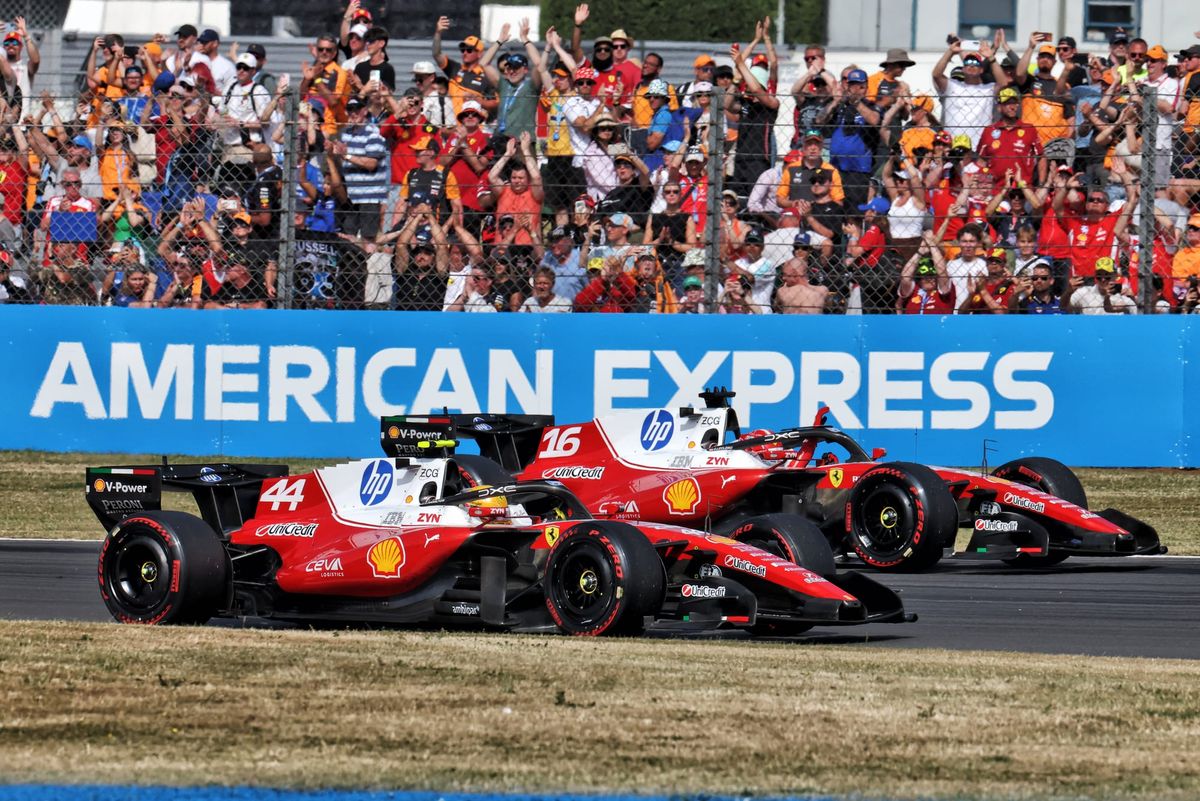
A much-needed victory in the British Grand Prix for Charles Leclerc provided a clear signal that he might have at last cracked the problems that have been holding him back in Formula 1 recently.
Leclerc has been through a rough patch of form, retiring from two out of the three races prior to Silverstone and crashing twice in that time, while watching team-mate Lewis Hamilton become increasingly assured and assertive inside Ferrari.
Just as Hamilton has grown increasingly confident after taking Ferrari’s first win of 2026 at Barcelona - talking of changes inside the Ferrari team and to the car that he has pushed for - so Leclerc has had to face a barrage of negative questions about his own form as the bad weekends piled up.
“Obviously there's a lot of negativity around me in general with narratives being created,” Leclerc said, “and it's never a nice environment to work in.”
So the first thing Leclerc had to do was try to block out that negativity and “keep our heads down” while trying to figure out how to get his season back on track. Step one was to “cancel that noise” and remember that “I didn't become a bad driver from one day to the other”.
As is often the case in this modern age, that process began with what you might call a ‘digital detox’. Leclerc basically stopped doomscrolling and put down his phone in order to have what he calls “the right picture of the situation” and not be unduly influenced by those negative storylines.
The irony is not lost on us here at The Race that we are now pumping Leclerc up into ‘hero’ status, after his drought-ending win!
But even though he ultimately owed it in part to the wheel shield failure that befell championship leader Kimi Antonelli late-on, the real significance of this result is what it means for Leclerc’s self-confidence and what it says about the evolving internal dynamic at Ferrari.
The details that made the difference
The Silverstone weekend actually began with Leclerc once again on the backfoot. As Hamilton took sprint pole by just 11 thousandths of a second over Antonelli, Leclerc qualified more than three tenths down on Hamilton in fifth - and finished the 17-lap sprint race almost 10 seconds behind his team-mate.
It was at this point Leclerc said he spotted something in Ferrari’s data that made him think he needed a change of approach: “Just a few things I saw on the data on Friday night, and I was like, OK, that might be things that just don't fit with my driving style.”
Obviously we don’t have access to Ferrari’s rich layer of data, but from this GP Tempo trace we can get a general sense of where Leclerc was shipping that time to Hamilton in sprint qualifying.
The delta shows there’s basically nothing to choose between them across the first part of the lap - Hamilton was quicker through the Village/Loop complex; Leclerc gained that time back through Brooklands and Luffield.
But Hamilton gained time on the following straight, through Copse - where he barely lifted off the throttle and used a higher gear than Leclerc did - and a massive chunk through the final chicane, where Leclerc arrived slower - presumably related to battery depletion - but also used significantly more throttle than Hamilton through the crucial exit phase of that sequence.
Leclerc also had spells through the lap where his engine’s RPM was higher and he was using a gear lower than Hamilton.
Come grand prix qualifying (data above), the picture shifted. Leclerc’s engine RPM and gear pattern was a close match for Hamilton’s, Leclerc gained on the straights he was previously losing time on, he gained on Hamilton through Copse and the Maggotts/Becketts sequence, gained a fraction through Stowe and was much better than before through the final chicane, with a throttle trace that more closely matched what Hamilton was doing.
Qualifying on the front row, alongside Antonelli and almost two tenths clear of Hamilton, was the foundation upon which Leclerc built his first F1 victory in more than 20 months, and this data suggests Leclerc made a fundamental adjustment to the way he was attacking these corners.
After grand prix qualifying, Leclerc spoke about facing a choice: between completely adjusting his driving style to replicate what Hamilton’s been doing recently, or trying to find a way to bring the Ferrari set-up into a place where Leclerc can do what comes naturally to him without paying a price.
“I went towards the second route,” he confirmed, “which was to stick with what I know worked in the past and try to find a way around with the car and with the tools I have available inside the car.”
Leclerc describes his own driving style as “quite aggressive” and we know in the past he has conjured some magical qualifying laps by attacking corner entries, overlapping the brakes and throttle to load up the outside tyres more progressively and carry huge corner speed without paying a penalty on the way out.
But he says he has found it “incredibly difficult to put things together” in these 2026 cars, with their smaller tyre profiles, reduced downforce and oddball, battery-dominated power units.
What’s noticeable from GP Tempo graphs is that Leclerc’s GP qualifying traces indicate a driver who was much more confident applying the throttle. Between Village and The Loop he was much more aggressive than the day before; the same between Brooklands and Luffield. There was no visible lift off the throttle at Copse and he was generally just being much more decisive with his inputs.
This would suggest that Leclerc had more confidence in how much rear grip his Ferrari was producing, and also that maybe Ferrari dialled in a set-up that allowed him to rotate the car better through those corners, so he could apply the throttle more aggressively without worrying he was still holding too much steering lock, or risking a sudden snap of oversteer.
Hamilton's role in Leclerc's turnaround
Leclerc described this process of improvement through the Silverstone weekend as “intuition mixed with feeling”, rather than a case of something “black and white” jumping out from the data, but it’s interesting to note how much closer his basic data trace was to Hamilton’s come grand prix qualifying - and Hamilton himself suggested he had played a major part in how Leclerc’s race winning weekend came together.
Hamilton has spoken recently about how essentially ignoring Ferrari’s pre-race simulator predictions has been helping him dial in better for race weekends.
At Silverstone, Hamilton suggested it was this same approach that was key to him being so strong in sprint qualifying, where everyone came into that session with only one practice session with which to judge reality against their expectations.
He said Ferrari’s simulator indicated “we should start in a much different place with the set-up” for Silverstone, but he and his team “decided to stay with the direction we would normally go”. And Hamilton says crucially, having followed the direction of the simulator initially, Leclerc then diverted to Hamilton’s set-up direction for the rest of the weekend.
“Charles started at where the sim would say to go,” Hamilton said. “The direction I was taking was ultimately the right one, and he migrated that way.”
Leclerc has already, since crashing out of his home race in Monaco, migrated to the Carbon Industrie brake material favoured by Hamilton - and that Hamilton says he had to push extremely hard behind the scenes for Ferrari to introduce. The front suspension too is another area Hamilton says Ferrari has adjusted for this season according to his preference.
But it’s also true that Ferrari has ultimately decided these directions are in the best interests of the entire team, not just Hamilton, and so Leclerc has had to adjust.
Team boss Fred Vasseur reckons what we’ve seen in Leclerc’s wayward form recently are the blips that can come while having to make these adjustments, before a driver finds their confidence with the changes.
When it came to the British Grand Prix itself, it was Hamilton paying the price for diverging from Leclerc’s preferred set-up direction - with Hamilton adjusting his front wing angle to reduce front grip, feeling the car was oversteering too much in qualifying, while Leclerc went in the opposite direction.
“I had the biggest understeer at the beginning of the race,” Hamilton said. “So he just pulled away from me. I couldn't even turn the car.”
Hamilton says he made some alterations to his car’s differential settings through the first stint of the race, to make it turn better, but by then “the gap was already huge”.
Had he not made that false start, where he says an involuntary movement of his hand on the clutch caused the car to move before the red lights went out, Hamilton would have finished second to Leclerc even with the late pitstop under the safety car that ultimately dropped him behind George Russell’s Mercedes.
But regardless of those mistakes, this was very much a race where Hamilton was made to look second best by Leclerc - for the first time since before F1’s enforced April hiatus.
As Hamilton said pre-weekend, “people tend to listen to you less” when you’re getting bad results, so this win should give Leclerc a much-needed boost in confidence.
The question now, as Leclerc well knows, is whether he can translate this marked improvement elsewhere.
Leclerc has been through a rough patch of form, retiring from two out of the three races prior to Silverstone and crashing twice in that time, while watching team-mate Lewis Hamilton become increasingly assured and assertive inside Ferrari.
Just as Hamilton has grown increasingly confident after taking Ferrari’s first win of 2026 at Barcelona - talking of changes inside the Ferrari team and to the car that he has pushed for - so Leclerc has had to face a barrage of negative questions about his own form as the bad weekends piled up.
“Obviously there's a lot of negativity around me in general with narratives being created,” Leclerc said, “and it's never a nice environment to work in.”
So the first thing Leclerc had to do was try to block out that negativity and “keep our heads down” while trying to figure out how to get his season back on track. Step one was to “cancel that noise” and remember that “I didn't become a bad driver from one day to the other”.
As is often the case in this modern age, that process began with what you might call a ‘digital detox’. Leclerc basically stopped doomscrolling and put down his phone in order to have what he calls “the right picture of the situation” and not be unduly influenced by those negative storylines.
The irony is not lost on us here at The Race that we are now pumping Leclerc up into ‘hero’ status, after his drought-ending win!
But even though he ultimately owed it in part to the wheel shield failure that befell championship leader Kimi Antonelli late-on, the real significance of this result is what it means for Leclerc’s self-confidence and what it says about the evolving internal dynamic at Ferrari.
The details that made the difference
The Silverstone weekend actually began with Leclerc once again on the backfoot. As Hamilton took sprint pole by just 11 thousandths of a second over Antonelli, Leclerc qualified more than three tenths down on Hamilton in fifth - and finished the 17-lap sprint race almost 10 seconds behind his team-mate.
It was at this point Leclerc said he spotted something in Ferrari’s data that made him think he needed a change of approach: “Just a few things I saw on the data on Friday night, and I was like, OK, that might be things that just don't fit with my driving style.”
Obviously we don’t have access to Ferrari’s rich layer of data, but from this GP Tempo trace we can get a general sense of where Leclerc was shipping that time to Hamilton in sprint qualifying.
The delta shows there’s basically nothing to choose between them across the first part of the lap - Hamilton was quicker through the Village/Loop complex; Leclerc gained that time back through Brooklands and Luffield.
But Hamilton gained time on the following straight, through Copse - where he barely lifted off the throttle and used a higher gear than Leclerc did - and a massive chunk through the final chicane, where Leclerc arrived slower - presumably related to battery depletion - but also used significantly more throttle than Hamilton through the crucial exit phase of that sequence.
Leclerc also had spells through the lap where his engine’s RPM was higher and he was using a gear lower than Hamilton.
Come grand prix qualifying (data above), the picture shifted. Leclerc’s engine RPM and gear pattern was a close match for Hamilton’s, Leclerc gained on the straights he was previously losing time on, he gained on Hamilton through Copse and the Maggotts/Becketts sequence, gained a fraction through Stowe and was much better than before through the final chicane, with a throttle trace that more closely matched what Hamilton was doing.
Qualifying on the front row, alongside Antonelli and almost two tenths clear of Hamilton, was the foundation upon which Leclerc built his first F1 victory in more than 20 months, and this data suggests Leclerc made a fundamental adjustment to the way he was attacking these corners.
After grand prix qualifying, Leclerc spoke about facing a choice: between completely adjusting his driving style to replicate what Hamilton’s been doing recently, or trying to find a way to bring the Ferrari set-up into a place where Leclerc can do what comes naturally to him without paying a price.
“I went towards the second route,” he confirmed, “which was to stick with what I know worked in the past and try to find a way around with the car and with the tools I have available inside the car.”
Leclerc describes his own driving style as “quite aggressive” and we know in the past he has conjured some magical qualifying laps by attacking corner entries, overlapping the brakes and throttle to load up the outside tyres more progressively and carry huge corner speed without paying a penalty on the way out.
But he says he has found it “incredibly difficult to put things together” in these 2026 cars, with their smaller tyre profiles, reduced downforce and oddball, battery-dominated power units.
What’s noticeable from GP Tempo graphs is that Leclerc’s GP qualifying traces indicate a driver who was much more confident applying the throttle. Between Village and The Loop he was much more aggressive than the day before; the same between Brooklands and Luffield. There was no visible lift off the throttle at Copse and he was generally just being much more decisive with his inputs.
This would suggest that Leclerc had more confidence in how much rear grip his Ferrari was producing, and also that maybe Ferrari dialled in a set-up that allowed him to rotate the car better through those corners, so he could apply the throttle more aggressively without worrying he was still holding too much steering lock, or risking a sudden snap of oversteer.
Hamilton's role in Leclerc's turnaround
Leclerc described this process of improvement through the Silverstone weekend as “intuition mixed with feeling”, rather than a case of something “black and white” jumping out from the data, but it’s interesting to note how much closer his basic data trace was to Hamilton’s come grand prix qualifying - and Hamilton himself suggested he had played a major part in how Leclerc’s race winning weekend came together.
Hamilton has spoken recently about how essentially ignoring Ferrari’s pre-race simulator predictions has been helping him dial in better for race weekends.
At Silverstone, Hamilton suggested it was this same approach that was key to him being so strong in sprint qualifying, where everyone came into that session with only one practice session with which to judge reality against their expectations.
He said Ferrari’s simulator indicated “we should start in a much different place with the set-up” for Silverstone, but he and his team “decided to stay with the direction we would normally go”. And Hamilton says crucially, having followed the direction of the simulator initially, Leclerc then diverted to Hamilton’s set-up direction for the rest of the weekend.
“Charles started at where the sim would say to go,” Hamilton said. “The direction I was taking was ultimately the right one, and he migrated that way.”
Leclerc has already, since crashing out of his home race in Monaco, migrated to the Carbon Industrie brake material favoured by Hamilton - and that Hamilton says he had to push extremely hard behind the scenes for Ferrari to introduce. The front suspension too is another area Hamilton says Ferrari has adjusted for this season according to his preference.
But it’s also true that Ferrari has ultimately decided these directions are in the best interests of the entire team, not just Hamilton, and so Leclerc has had to adjust.
Team boss Fred Vasseur reckons what we’ve seen in Leclerc’s wayward form recently are the blips that can come while having to make these adjustments, before a driver finds their confidence with the changes.
When it came to the British Grand Prix itself, it was Hamilton paying the price for diverging from Leclerc’s preferred set-up direction - with Hamilton adjusting his front wing angle to reduce front grip, feeling the car was oversteering too much in qualifying, while Leclerc went in the opposite direction.
“I had the biggest understeer at the beginning of the race,” Hamilton said. “So he just pulled away from me. I couldn't even turn the car.”
Hamilton says he made some alterations to his car’s differential settings through the first stint of the race, to make it turn better, but by then “the gap was already huge”.
Had he not made that false start, where he says an involuntary movement of his hand on the clutch caused the car to move before the red lights went out, Hamilton would have finished second to Leclerc even with the late pitstop under the safety car that ultimately dropped him behind George Russell’s Mercedes.
But regardless of those mistakes, this was very much a race where Hamilton was made to look second best by Leclerc - for the first time since before F1’s enforced April hiatus.
As Hamilton said pre-weekend, “people tend to listen to you less” when you’re getting bad results, so this win should give Leclerc a much-needed boost in confidence.
The question now, as Leclerc well knows, is whether he can translate this marked improvement elsewhere.