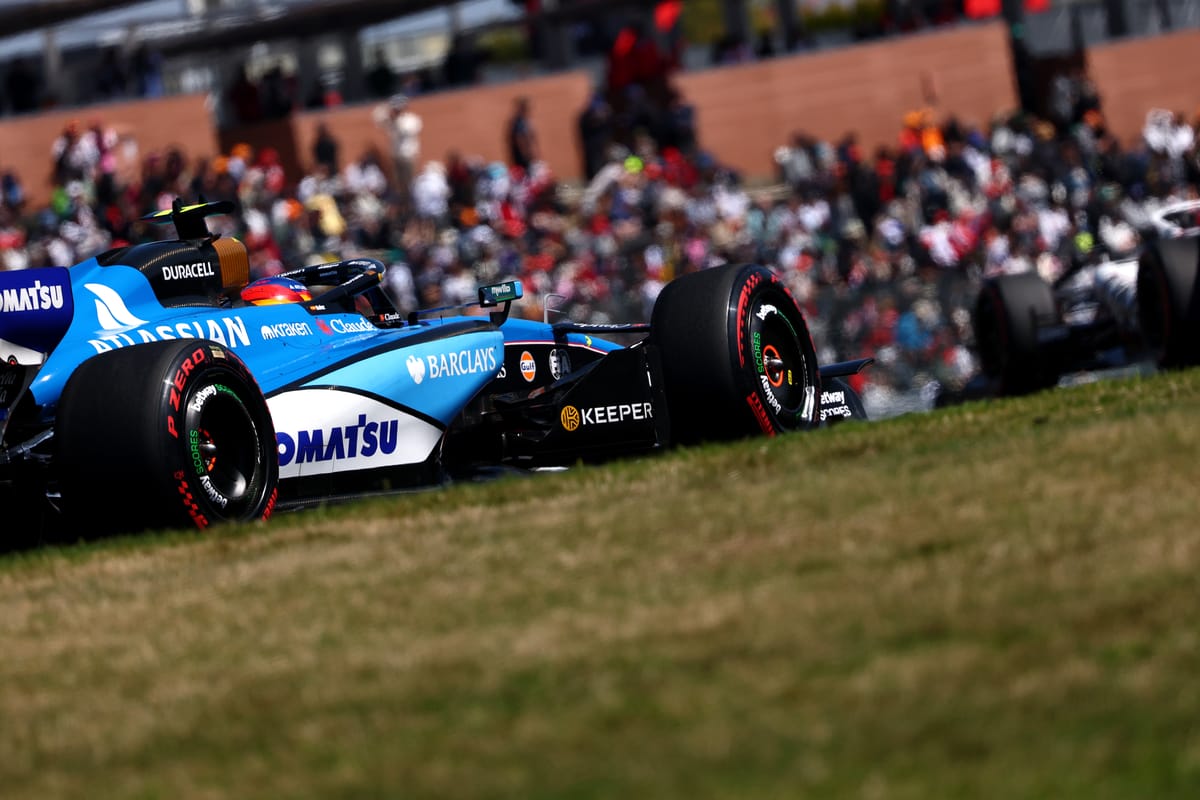
The late changes to Formula 1’s charging limits for qualifying at the Japanese Grand Prix have helped, but there is still a glaring problem over one lap at Suzuka.
As expected, the energy-starved engines cannot keep deploying full electric power for long enough on the longest Suzuka straights and the recharging demands mean superclipping kicks in to boot.
The result is an extremely obvious and quite painful speed drop-off while the drivers remain on full throttle, most noticeably through the famed 130R and into the final chicane, where there were speed reductions of up to 50km/h before the drivers even braked.
This is something even the most prominent positive voices about F1 2026 have acknowledged as a problem. Seven-time world champion Lewis Hamilton said: “It's not great when you have to super clip. It means you arrive in some places and you're kind of coasting in because you've no power – so that's probably the least enjoyable part of the rule change for the circuit.”
Hamilton is being kind because ‘the least enjoyable’ is really the worst. We shouldn’t pretend 130R has remained a mega driving corner - it has been easy flat for a long time although maybe with the reduced downforce of the 2026 cars some of its challenge could have been revived - but it is the drawn-out coasting down to a much lower speed before diving on the brakes for the chicane that is a tough watch.
“That’s always a painful feeling,” said Haas driver Ollie Bearman.
“Some of those corners which before were balls to the wall are not the case anymore, but that’s what we’re having to get used to and still I think there’s a skill in getting everything out of it.
“It’s ok, it’s a new reality but it’s still fun to drive on a track like this.”
The silver lining is that it is not worse. The 8MJ recharge limit, down from 9MJ, means that drivers are not saving energy as much as they could have been throughout the lap and that has saved F1 from even more extreme charging methods.
“Compared to what we had in the simulator with the amount of super clipping, reducing the harvest has definitely helped and now at least super clipping seems more controlled,” said Williams driver Carlos Sainz.
“Still the amount of speed that we lose on 130R when the straight mode closes and the battery cuts – and into Spoon 1 and Degner 1 – in my opinion is a bit too much.
“But it's getting to a level that I hope with a couple of more tweaks it can get to a level that now hopefully we stop talking about it hopefully for the future.”
His fellow Grand Prix Drivers Association director George Russell agreed. The Mercedes driver called the reduction “100% the right decision” and added: “Arguably we could have gone even further.” And this might have been a good trade. The overall laptime would have been slower with less electric power to deploy over the lap, but Russell reckons it would have been maybe a second in total and as the peak speed would have been lower, the decline would have been less dramatic.
A different kind of plaster, then, but at least something less overtly disappointing. Hamilton claimed that Suzuka is “still awesome to drive”, but mighty cornering challenges like the opening sweeps of sector one have become power-limited, rather than grip-limited, and the tightrope of the Degners is diminished in its challenge. No doubt it is still hard - and it still caught drivers out on Friday - but the edge has been taken away slightly.
This is how Pierre Gasly described the challenge of Degner 1 on Thursday, for example: “The track edges are grass and gravel. You have an ideal line with a bit of kerb on the inside, a bit of kerb on the outside. You arrive, entry speed at 290km/h, a millimetre from the grass, so you're trying to open the corner as much as possible, but obviously, you need extreme precision.
“The moment you enter, you also have that sort of compression at the apex. If you're too tight, that kerb doesn't give you any mercy, it sends you straight off. If you miss the apex, very quickly the corner becomes a lot tighter. And if you just overdo it slightly, you're onto the kerb and you have a big penalty.
“So for very small imprecision, the consequence is huge. Then afterwards, where do you place that cursor of risk and reward, which is a bit of a game throughout the whole weekend, pushing that more and more and more and more to really get to nail it for the quali.”
This is why Sainz laments the reduction of power into those corners. And it isn’t just superclipping. The Degners, the opening few sweeps, and the two left-hand corners making up the long and tricky Spoon Curves onto the returning straight to 130R are all what can get colloquially referred to in F1 jargon as ‘zero kilowatt zones’.
These corners have been designated by the FIA as places where teams can cut the MGU-K instantly, which means no electric power at all. And Sainz reckons everyone has worked out that the opening sector, for example, it is best to have no MGU-K use at all - which means only the V6 internal combustion engine is being used through those corners, just over 50% of the engine’s actual performance potential.
This explains why, when watching the Esses from trackside, steady-state laps (i.e. not individual ‘push’ laps) were so unsettingly sedate at a part of the track where it’s usually much more visually challenging. It at least means that drivers are not doing anything weird there, but they are clearly down on power.
“It's not good enough, not as good as it used to be,” said Sainz.
“Is it a disaster? No, but it's not what F1, I think, should be. It needs to get better than this.”
As expected, the energy-starved engines cannot keep deploying full electric power for long enough on the longest Suzuka straights and the recharging demands mean superclipping kicks in to boot.
The result is an extremely obvious and quite painful speed drop-off while the drivers remain on full throttle, most noticeably through the famed 130R and into the final chicane, where there were speed reductions of up to 50km/h before the drivers even braked.
This is something even the most prominent positive voices about F1 2026 have acknowledged as a problem. Seven-time world champion Lewis Hamilton said: “It's not great when you have to super clip. It means you arrive in some places and you're kind of coasting in because you've no power – so that's probably the least enjoyable part of the rule change for the circuit.”
Hamilton is being kind because ‘the least enjoyable’ is really the worst. We shouldn’t pretend 130R has remained a mega driving corner - it has been easy flat for a long time although maybe with the reduced downforce of the 2026 cars some of its challenge could have been revived - but it is the drawn-out coasting down to a much lower speed before diving on the brakes for the chicane that is a tough watch.
“That’s always a painful feeling,” said Haas driver Ollie Bearman.
“Some of those corners which before were balls to the wall are not the case anymore, but that’s what we’re having to get used to and still I think there’s a skill in getting everything out of it.
“It’s ok, it’s a new reality but it’s still fun to drive on a track like this.”
The silver lining is that it is not worse. The 8MJ recharge limit, down from 9MJ, means that drivers are not saving energy as much as they could have been throughout the lap and that has saved F1 from even more extreme charging methods.
“Compared to what we had in the simulator with the amount of super clipping, reducing the harvest has definitely helped and now at least super clipping seems more controlled,” said Williams driver Carlos Sainz.
“Still the amount of speed that we lose on 130R when the straight mode closes and the battery cuts – and into Spoon 1 and Degner 1 – in my opinion is a bit too much.
“But it's getting to a level that I hope with a couple of more tweaks it can get to a level that now hopefully we stop talking about it hopefully for the future.”
His fellow Grand Prix Drivers Association director George Russell agreed. The Mercedes driver called the reduction “100% the right decision” and added: “Arguably we could have gone even further.” And this might have been a good trade. The overall laptime would have been slower with less electric power to deploy over the lap, but Russell reckons it would have been maybe a second in total and as the peak speed would have been lower, the decline would have been less dramatic.
A different kind of plaster, then, but at least something less overtly disappointing. Hamilton claimed that Suzuka is “still awesome to drive”, but mighty cornering challenges like the opening sweeps of sector one have become power-limited, rather than grip-limited, and the tightrope of the Degners is diminished in its challenge. No doubt it is still hard - and it still caught drivers out on Friday - but the edge has been taken away slightly.
This is how Pierre Gasly described the challenge of Degner 1 on Thursday, for example: “The track edges are grass and gravel. You have an ideal line with a bit of kerb on the inside, a bit of kerb on the outside. You arrive, entry speed at 290km/h, a millimetre from the grass, so you're trying to open the corner as much as possible, but obviously, you need extreme precision.
“The moment you enter, you also have that sort of compression at the apex. If you're too tight, that kerb doesn't give you any mercy, it sends you straight off. If you miss the apex, very quickly the corner becomes a lot tighter. And if you just overdo it slightly, you're onto the kerb and you have a big penalty.
“So for very small imprecision, the consequence is huge. Then afterwards, where do you place that cursor of risk and reward, which is a bit of a game throughout the whole weekend, pushing that more and more and more and more to really get to nail it for the quali.”
This is why Sainz laments the reduction of power into those corners. And it isn’t just superclipping. The Degners, the opening few sweeps, and the two left-hand corners making up the long and tricky Spoon Curves onto the returning straight to 130R are all what can get colloquially referred to in F1 jargon as ‘zero kilowatt zones’.
These corners have been designated by the FIA as places where teams can cut the MGU-K instantly, which means no electric power at all. And Sainz reckons everyone has worked out that the opening sector, for example, it is best to have no MGU-K use at all - which means only the V6 internal combustion engine is being used through those corners, just over 50% of the engine’s actual performance potential.
This explains why, when watching the Esses from trackside, steady-state laps (i.e. not individual ‘push’ laps) were so unsettingly sedate at a part of the track where it’s usually much more visually challenging. It at least means that drivers are not doing anything weird there, but they are clearly down on power.
“It's not good enough, not as good as it used to be,” said Sainz.
“Is it a disaster? No, but it's not what F1, I think, should be. It needs to get better than this.”